

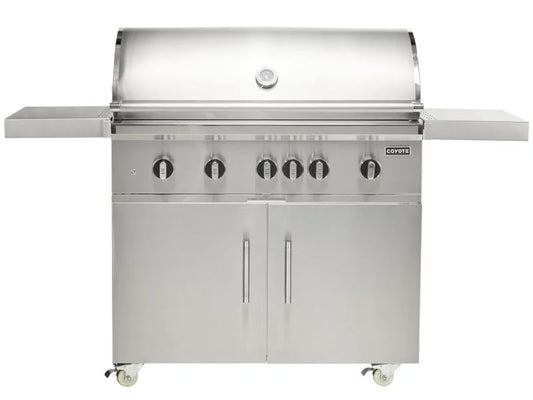
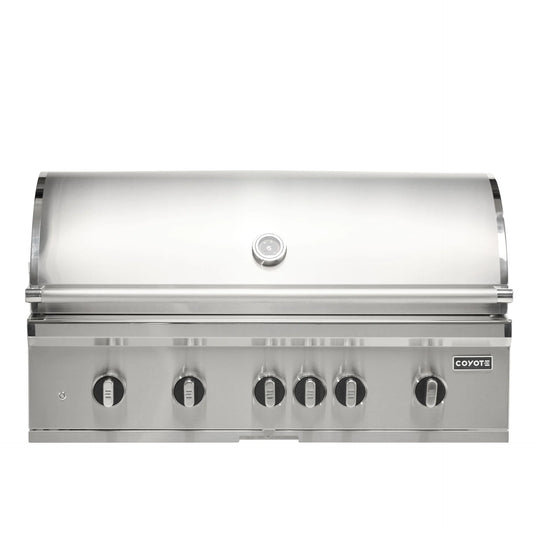
304 vs 443 Stainless Steel: Which Is Better for Outdoor Grills?

Grill listings throw two numbers at you — 304 and 443 — and rarely explain either one. This page explains what the two grades actually are, what the published metallurgy does and does not support, and why the more useful question is not “which grade” but “which part of the grill is made of what.”
Everything below is drawn from ASTM A240, the mills that produce these grades (JFE Steel, Outokumpu, North American Stainless), and the stainless industry bodies (SSINA, ISSF, BSSA, ASSDA, IMOA). Where those sources disagree, or where a figure simply is not published, this page says so instead of filling the gap.
The short answer
The two grades are closer than the marketing suggests, and they are close in different directions:
- 443 has more chromium. ASTM A240 gives it 20.0–23.0% chromium against 17.5–19.5% for 304, and chromium is what forms the passive film that makes steel stainless.
- 304 has nickel; 443 has none. Nickel is what makes 304 austenitic — formable, non-magnetic, stronger when hot. It is not what makes it rust-resistant, which is the single most common mistake in grill copy.
- Neither grade contains molybdenum, and molybdenum is what a corrosion engineer specifies for salt air. On the published evidence, neither 304 nor 443 is a coastal-rated alloy.
So if you are choosing between a 304 grill and a 443 grill purely on the alloy number, you are choosing between two grades that sit closer together than the price difference implies. What actually separates grills in the field is which components get which alloy, how smooth the surface finish is, whether the grill is covered, and how often it gets rinsed. The rest of this page covers all four.
What 304 stainless steel is
304 is UNS S30400, an austenitic chromium-nickel stainless steel covered by ASTM A240 — the specification that governs stainless plate, sheet and strip, which is what a grill hood, cook box and cart panel are made from. Unlike 443, “Type 304” is a genuine AISI type designation and appears as such in the A240 tables.
The universally safe way to describe it is nominally 18% chromium, 8% nickel. Every source agrees on that characterization. The precise limits, though, depend on which ASTM specification you read:
| Element | ASTM A240 (plate, sheet, strip) | ASTM A276 / legacy AISI (bar, shapes) |
|---|---|---|
| Chromium | 17.5 – 19.5% | 18.0 – 20.0% |
| Nickel | 8.0 – 10.5% | 8.0 – 10.5% or 8.0 – 11.0%, depending on the source |
| Carbon | 0.07% max | 0.08% max |
| Manganese | 2.00% max | 2.00% max |
| Nitrogen | 0.10% max | 0.10% max |
| Molybdenum | None specified | None specified |
That is a real disagreement between two ASTM product specifications for the same UNS number, not a transcription error — which is exactly why you should be suspicious of any grill page that quotes a single precise chromium figure for 304 without naming the standard it came from.
What the nickel is actually doing
Grill copy routinely says nickel is what gives 304 its rust resistance. The metallurgy does not support that. Nickel is the austenite-forming addition: it stabilizes the austenitic crystal structure at room temperature, and that structure is what gives 304 its formability, its weldability, its toughness at low temperatures, and its strength at high temperatures. The International Stainless Steel Forum states plainly that nickel content is left out of the standard pitting-resistance formula because in most applications it plays no role in resistance to pitting corrosion.
Nickel buys real things. Corrosion resistance, in this comparison, is mostly not one of them — chromium is.
What “443” is — and why the name is confusing
This is worth getting right, because almost nobody in the grill industry explains it.
There is no AISI or ASTM “Type 443”
The grade is real and it is standardized, but its actual designation is UNS S44330. It appears in the ASTM A240 tables with the Type column left blank — ASTM does not assign it a type number. The classic AISI ferritic types are 405, 409, 429, 430, 434, 436, 439, 442, 444 and 446. There is no 443 among them, and neither SSINA’s ferritic composition table nor the ISSF’s taxonomy of ferritic grades lists one.
The number “443” comes from two other places:
- The Japanese standard. JIS G4304/G4305 designates this grade SUS443J1.
- A mill trade name. JFE Steel markets it as JFE443CT, and cites UNS S44330 under ASTM A240 on its own datasheet.
In Europe the identical grade is EN 1.4622, which Outokumpu sells as Core 4622 and never calls “443” at all. So when a grill is advertised as “443 stainless,” that is the market’s shorthand — borrowed from a Japanese standard and a Japanese mill’s brand name — not an American grade designation. It does not mean the steel is off-spec. It does mean you should not expect to find “Type 443” in an ASTM table, because it is not there.
What is in it
Per ASTM A240, UNS S44330:
| Element | ASTM A240 limit for UNS S44330 |
|---|---|
| Chromium | 20.0 – 23.0% |
| Nickel | None specified — mills market the grade as nickel-free |
| Molybdenum | None specified |
| Copper | 0.30 – 0.80% |
| Titanium + niobium (combined) | 8 × (carbon + nitrogen) minimum, 0.80% max |
| Carbon | 0.025% max |
| Nitrogen | 0.025% max |
| Manganese | 1.00% max |
Two things are worth pulling out. First, the carbon limit is roughly a third of 304’s, and the titanium/niobium addition is there to tie up what carbon remains — that is what “stabilized” means, and it is what keeps the grade weldable without losing corrosion resistance at the weld. Second, both major mills land on about 21% chromium as their working nominal, arriving there independently.
One practical wrinkle: stabilization differs by mill inside the same grade. JFE’s version is titanium-stabilized; Outokumpu’s is dual-stabilized with both niobium and titanium. Both satisfy S44330.
304 vs 443: the numbers, not the adjectives
Every figure in this table is published by a mill, a standard, or a stainless industry body. Where a figure is not published, the cell says so.
| Property | 304 (UNS S30400) | 443 (UNS S44330) | What it means for a grill |
|---|---|---|---|
| Family | Austenitic | Ferritic | Determines nearly everything below |
| Chromium | 17.5 – 19.5% (A240) | 20.0 – 23.0% | Chromium forms the passive film |
| Nickel | 8.0 – 10.5% | None | Structure and hot strength, not rust resistance |
| Molybdenum | None | None | Neither grade has the salt-air alloying element |
| Pitting index (PREN) | ≈ 18 | ≈ 21 | A modest edge to 443 — see the arithmetic below |
| Chloride stress corrosion cracking | Susceptible | Resistant | A genuine ferritic advantage, with a caveat |
| Magnetic? | No when annealed; slightly magnetic after cold work | Yes | A magnet tells you the family, not the quality |
| Thermal expansion | ≈ 16 – 17.3 ×10⁻⁶/°C | ≈ 10 – 10.5 ×10⁻⁶/°C | 443 moves about 40% less per degree of heating |
| Thermal conductivity | ≈ 15 – 16 W/m·°C | ≈ 22 – 25 W/m·°C | 443 moves heat through itself faster |
| Max service temperature in air | ≈ 870 °C (1600 °F) intermittent | Not published by the manufacturer | No mill or standards body publishes one for this grade |
| High-temperature strength | Better | Lower | Austenitics hold strength when hot |
| Work hardening / formability | Work-hardens substantially; very formable | Work-hardens less; forms like carbon steel | A manufacturing consideration, not a buying one |
| Relative cost | Higher | Lower | Driven by nickel price — see below |
Which one resists corrosion better?
Closer than you would guess, and the honest answer has three parts.
Pitting: a small, calculable edge to 443
The industry-standard index is the Pitting Resistance Equivalent Number. The ISSF form is PREN = %Cr + 3.3 × %Mo. Neither of these grades contains molybdenum, so that term is zero for both and the comparison collapses to chromium:
- 304 at Outokumpu’s nominal 18.1% chromium: PREN = 18.1 + 0 = 18 (the figure Outokumpu publishes).
- 443 at 21% chromium: PREN = 21 + 0 = 21 (again, the published figure).
So 443 outscores 304 by roughly two to three points on the pitting index. That is real, and it is reproducible from the composition ranges in ASTM A240 without taking any mill’s word for it.
It is also modest, and PREN is a narrow instrument. It does not capture crevice corrosion, stress corrosion cracking, weld-zone behavior, or surface finish — and, by the ISSF’s own explanation, it structurally cannot express anything nickel contributes. Two to three PREN points does not move either grade into a different class.
The mills themselves are not in full agreement on how to characterize it. JFE claims corrosion resistance “equal or superior” to 304. Outokumpu — also selling the ferritic grade — claims only that pitting resistance is “comparable” to 304 and 304L. When the two companies with the strongest incentive to praise a grade land on different adjectives, the more conservative one is the safer planning assumption.
Chloride stress corrosion cracking: a real ferritic advantage
This is the one place where the ferritic grade wins decisively and the evidence is not close. Austenitic stainless steels are the family most susceptible to chloride stress corrosion cracking, and susceptibility peaks at around 8% nickel — which is precisely where 304 sits. Ferritic grades are very resistant to it. JFE demonstrates this directly in a magnesium chloride U-bend test: 304 cracks, the ferritic does not.
The caveat matters as much as the finding. Stress corrosion cracking needs sustained tensile stress plus chlorides plus, usually, heat — and every published threshold comes from immersion and process-plant service, not from grills. No source documents chloride stress corrosion cracking as an observed failure mode in outdoor grills. It is a correctly attributed metallurgical advantage. It is not a reason to expect your 304 grill to crack.
Crevice corrosion: the gap nobody fills
Worth saying plainly, because it is the most useful thing on this page: no qualifying source publishes a crevice corrosion comparison between these two grades. And crevices — bolted joints, spot welds, lapped panel seams, burner mounts, the underside of a control panel — are where outdoor grills actually corrode first. That is an evidence gap, not a tie, and anyone who tells you otherwise is filling it with something other than data.
What this means if you are on the coast
We sell into the Lowcountry, so this comes up constantly, and the honest answer is not the one either alloy’s marketing would give you.
The Australian Stainless Steel Development Association — whose guidance exists because coastal corrosion is a national problem there — states that Grade 316, or a grade with equivalent corrosion resistance, should be selected as a minimum within five kilometers of the surf. The International Molybdenum Association’s ferritic recommendation for corrosive exteriors is 444, which carries 1.75–2.50% molybdenum. Actual seawater immersion or regular splashing calls for super duplex, super ferritic or 6% molybdenum super austenitic grades, which are nowhere near anything in the grill market.
Neither 304 nor 443 contains molybdenum. So a coastal buyer choosing between them is choosing between two grades that both sit below the recommended coastal threshold, with 443 holding a modest chromium-based edge and a real advantage in stress corrosion cracking resistance. That is a considered conclusion from the published guidance, not a quote from any single source — but it follows directly from the fact that neither grade has the element the guidance is built around.
The practical consequence: on the coast, the variables you can actually control matter more than the alloy number. Those are surface finish, whether salt deposits are allowed to sit, and rinsing frequency. ASSDA recommends a surface smoother than 0.5 µm Ra, and a wash schedule ranging from once a year where deposits do not accumulate to four to twelve times a year in sheltered spots where they do — the underside of an overhang or a run of island that rain never reaches. Chloride-containing cleaning products should be avoided or rinsed off thoroughly.
A grill cover and a hose do more for a coastal installation than the difference between these two grades. The same logic applies to the rest of the island — we cover it in our guide to outdoor kitchen materials, stone and countertops.
Heat: what the numbers support, and what they don’t
304 has a maximum service temperature in air of roughly 870 °C (1600 °F) under intermittent conditions. There is a counter-intuitive detail here worth knowing: for austenitic grades the intermittent limit is the lower one — 1600 °F intermittent against 1700 °F continuous — because the higher thermal expansion causes the protective oxide layer to flake off on each heating and cooling cycle. Ferritic grades reverse that pattern, tolerating higher intermittent than continuous temperatures.
No mill and no standards body publishes a maximum service temperature for UNS S44330. SSINA’s temperature table covers 304, 316, 309, 310, 410, 420 and 430, and contains no entry for this grade. You will occasionally see 430’s figures quoted as though they were 443’s. They are not; 430 is a different alloy with different chemistry. We do not publish a number we cannot source.
What is well established is thermal expansion: 443 moves about 40% less than 304 for the same temperature rise. That is a genuine difference and the physics is straightforward — less dimensional change per cycle, less thermally induced stress in a restrained part.
What does not follow from it is the claim you will see made: that 304 hoods warp and 443 hoods do not. No source documents warping, panel distortion or hood discoloration as a measured, grade-attributable outcome in grills. The expansion numbers support a directional argument. They do not license the conclusion, and we are not going to pretend otherwise.
Cutting the other way: 304 has better elevated-temperature strength than the ferritic family. Lower expansion is a 443 advantage; hot strength is a 304 advantage. Both are true at the same time.
Does stainless steel rust?
Yes, in two distinct ways that get confused with each other constantly.
Tea staining is surface discoloration — a brown or rust-colored film, most often in coastal air. Both ASSDA and IMOA are explicit that it is cosmetic: it does not affect the structural integrity or the service life of the material. It is most common within about five kilometers of the surf, though ASSDA notes it can occur twenty kilometers or more inland given wind exposure, pollution, sheltering from rain, or higher temperatures. 304 in a marine environment, in ASSDA’s words, will probably become tea stained.
Free-iron contamination is different and is not a grade problem at all. Grinding, machining, mechanical damage or contact with carbon steel can leave iron particles embedded in a stainless surface, and those particles rust. It happens to any grade. So does the chromium-depleted layer left underneath the oxide after welding or other heating, which reduces corrosion resistance locally until it is pickled off.
What actually changes the outcome is cleaning. Frequent washing — by heavy rain or by hand — prevents the accumulation of the corrosive deposits that drive both problems. That is true of 304 and of 443 in equal measure.
Why “a 304 grill” is a misleading phrase
This is the part that changes how you shop.
A built-in grill is not made of one alloy. The hood, the cook box, the burners, the flame tamers or briquette trays, the grates, the fasteners and the control panel can each be a different material, chosen for what that part has to survive. A burner sits in direct flame and drains grease; a hood sits in weather; a fastener sits in a crevice. Those are three different engineering problems.
Here is what that looks like in practice, using Summerset’s three built-in series — every value below is taken from Summerset’s own published specifications:
| Component | Sizzler | Sizzler Pro | TRL Pro |
|---|---|---|---|
| Body / construction | #443 | #443 | #304 |
| Hood | #443, 16 ga. double-lined | #443, 16 ga. double-lined | Not published by the manufacturer |
| Main burners | #304 tube burners | #202 cast stainless | Not published by the manufacturer |
| Burner covers | #443 flame tamers | Briquette system, material not published | Briquette system, material not published |
| Cooking grates | Alloy not published | Alloy not published | Grade not published |
Read that table again. The two Summerset built-in grills marketed on a 443 body use 304 burners — the part that lives in the flame gets the austenitic grade, because hot strength is where nickel earns its keep. Meanwhile the grill marketed on 304 construction does not publish a burner grade at all: its spec table says “cast stainless” with no number while its marketing copy elsewhere says #304, so we do not publish one either.
Calling any of these “a 443 grill” or “a 304 grill” flattens all of that into a single number that describes, at best, the body panel. The useful question to ask a dealer is not “what grade is it” but “what grade is the hood, what grade are the burners, and what is the warranty on each.”
You will also find, as we did while checking this, that manufacturers frequently publish a body grade and nothing else. That is not evasion so much as convention — but it does mean a comparison built only on the advertised number is comparing one panel to one panel.
Why 443 costs less
One reason, and it has nothing to do with quality control: nickel.
Ferritic grades contain essentially no nickel, and nickel is the expensive, volatile input in stainless steel. The ISSF documents London Metal Exchange nickel ranging from roughly $2,000 to $48,000 per tonne across 1999–2007 — better than a twentyfold swing — while chromium has historically been comparatively stable. That volatility is why mills developed and promoted stabilized ferritic grades in the first place, and why Outokumpu markets its ferritic line specifically as more price-stable.
So a 443 grill is not cheaper because the steel is worse. It is cheaper because it does not contain a commodity whose price has historically moved by an order of magnitude. What you give up is the austenitic structure — hot strength, formability, non-magnetic behavior — not chromium, of which it has more.
The magnet test: what it does and doesn’t tell you
Ferritic grades, including 443, are magnetic. 304 is non-magnetic in the annealed condition. So a magnet will distinguish the two families, and that much is reliable.
Two things it will not tell you. First, 304 becomes slightly magnetic after cold working — so a deep-drawn part, a folded panel edge or a formed corner in genuine 304 can attract a magnet. A weak pull at a bend is not evidence of a substitution. Second, and more importantly, magnetism says nothing about quality or corrosion resistance. The magnet tells you the crystal structure. It does not tell you the chromium content, the surface finish, the weld quality or the gauge — all of which matter more to how the grill ages.
How to use this when you’re actually shopping
A short, defensible version of everything above:
- Do not pay a large premium for the alloy number alone. On published metallurgy, the two grades are close, and 443 holds a small edge on the pitting index.
- Ask which component is which. A 443 body with 304 burners is a coherent, well-engineered design. So is a 304 body. A grill that publishes nothing below the body panel is telling you something by omission.
- Weight and gauge matter. A heavier panel in either grade outlasts a thin one, and gauge is usually published when grade is.
- Look at the joints. Crevices corrode first, and that is true of both grades.
- If you are near salt air, budget for care, not for alloy. A cover, a rinse and a smooth finish will outperform the difference between these two grades.
- Read the warranty. A manufacturer’s own coverage on the body versus the burners is a better signal of what it expects to fail than any grade number on the spec sheet.
If you want to see how this plays out across specific series, our Coyote C-Series vs CL-Series vs SL-Series comparison, Summerset Sizzler vs Sizzler Pro vs TRL Pro guide and American Made Grills series guide each break construction down series by series. If you already know the size you need, our 42-inch guide and our 30-inch guide compare specific models with their cutout dimensions. You can also browse built-in grills by brand: Coyote, Summerset and American Made Grills.
And if you have not settled on built-in construction yet, our comparison of built-in vs freestanding grills covers that decision first — it changes which materials you should care about, because a cart grill can be rolled into a garage and a built-in cannot.
Common questions
Is 443 stainless steel better than 304?
Not in a way that supports a simple ranking. 443 has more chromium (20.0–23.0% vs 17.5–19.5%), scores about two to three points higher on the pitting resistance index, resists chloride stress corrosion cracking that 304 is vulnerable to, and expands about 40% less when heated. 304 has better strength at high temperature, better formability, and the austenitic structure that makes it the conventional choice for parts that see direct flame. Neither contains molybdenum, so neither is a coastal-rated grade.
Does 443 stainless steel rust?
It can show surface staining, as any stainless can. Tea staining is cosmetic discoloration that does not affect structural integrity or service life, and it happens to 304 as well — ASSDA notes that 304 in a marine environment will probably become tea stained. Free-iron contamination from fabrication or contact with carbon steel also rusts on any grade. Regular rinsing prevents both.
Is 443 stainless steel magnetic?
Yes. It is a ferritic grade, and ferritic stainless steels are magnetic. 304 is non-magnetic when annealed but becomes slightly magnetic after cold working, so a formed or drawn 304 part may attract a magnet at the bend.
Is 443 stainless steel good for coastal or salt-air environments?
Better than its chromium content alone would suggest, and better than 304 on stress corrosion cracking — but it is not a marine grade. It contains no molybdenum. The coastal guidance from ASSDA sets 316 or equivalent as the minimum within five kilometers of the surf, and IMOA’s ferritic recommendation for corrosive exteriors is 444, which does contain molybdenum. For a grill within sight of salt water, cleaning frequency, surface finish and a cover matter more than the choice between 304 and 443.
What is the difference between 304 and 316 stainless steel?
Molybdenum. 316 adds it; 304 does not. Molybdenum materially raises resistance to pitting and crevice corrosion in chloride environments, which is why 316 is the grade specified for marine and coastal service. It is uncommon in grill construction because of cost.
Why do some grills use 443 for the body and 304 for the burners?
Because the two parts face different problems. A burner sits in direct flame, where 304’s better elevated-temperature strength is an advantage. A body panel sits in weather, where 443’s higher chromium content and lower thermal expansion are advantages, and where the cost saving is largest because the panel is the biggest piece of steel in the grill. Summerset’s Sizzler is built exactly this way.
Is there an ASTM grade called 443?
No. ASTM A240 lists the grade as UNS S44330 with the Type column blank. The name “443” comes from the Japanese standard JIS G4304/G4305, which designates it SUS443J1, and from JFE Steel’s trade name JFE443CT. In Europe the same grade is EN 1.4622. The steel is standardized and legitimate; the name is just not an American one.
How hot can 443 stainless steel get?
No mill or standards body publishes a maximum service temperature for UNS S44330, so we do not quote one. Figures circulating for “443” are usually 430’s, and 430 is a different alloy. For reference, 304 is rated to roughly 870 °C (1600 °F) intermittent service in air.
Talk it through with someone who has the spec sheets open
If you are weighing two specific grills and trying to work out whether the construction difference justifies the price difference, that is a conversation worth having rather than a table worth reading. We are an authorized dealer for every brand we carry, so we have the manufacturer documentation, and we will tell you when the published specs do not support the marketing.
Call 843-212-7209, or start with our grill finder if you would rather narrow things down first. You can also browse all built-in grills or read our outdoor kitchen planning guide if you are still laying out the island.
Sources
Composition ranges and grade designations are from ASTM A240/A240M. Property data and corrosion guidance are from the Specialty Steel Industry of North America, the International Stainless Steel Forum, the British Stainless Steel Association, the Australian Stainless Steel Development Association, the International Molybdenum Association, the Nickel Institute, and the published datasheets of JFE Steel, Outokumpu and North American Stainless. Component-level grades are from each manufacturer’s own published specifications and owner’s manuals. Where those sources conflict or are silent, this page says so rather than estimating.