

Built-In vs. Freestanding Grills: Which Is Right for Your Outdoor Kitchen?

Almost every guide to this question tells you that built-in grills and freestanding grills are fundamentally different appliances, and that building a cart grill into an island is dangerous. We went through the installation manuals for the brands we carry to check that, and for most of them it is not what the manufacturer actually says.
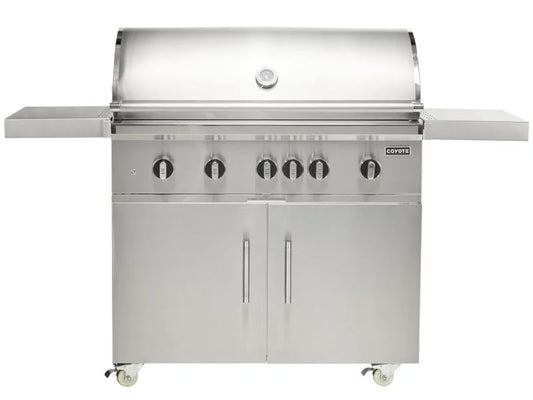
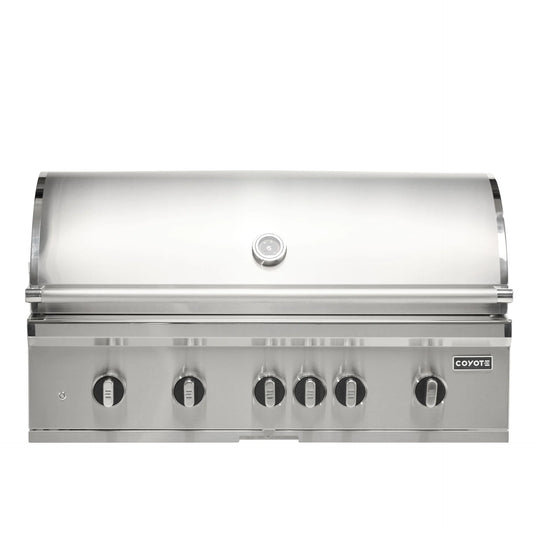
In most cases the freestanding grill is the built-in grill, sitting in a cart. Same model number, same burners, same BTU, same warranty. What decides whether a grill can go into an island is not the cart — it is the appliance’s listing and how the island itself is built. This page explains the real constraints, with the manufacturers’ own wording.
The short answer
- Choose a built-in head if you are building an island and want the finished, integrated result, and you are prepared to handle the cutout, the enclosure requirements, ventilation and a permanent gas line.
- Choose a cart if you want to cook this month rather than next season, if you rent or expect to move, if your patio is small, or if you would rather put the island budget into the grill itself.
- You are usually not giving up grill quality by choosing the cart — in the brands below, it is the same head either way.
The part nobody tells you: it is usually the same grill
We compared the published specifications for three models that are sold both ways. Not “similar” models — the same model, in both configurations.
| Model | Built-in | Freestanding | Published difference |
|---|---|---|---|
| Blaze Premium LTE 32 | BLZ-4LTE2-NG / -LP | BLZ-4LTE2-NG / -LP plus cart BLZ-4-CART | None. Blaze’s own cart page says it “holds BLZ-4-NG/LP and BLZ-4LTE2-NG/LP grill models” — the built-in head’s part number |
| Coyote C1C28 | C1C28NG / C1C28LP | C1C28NG-FS / C1C28LP-FS | None. Coyote covers both in one manual with one specification table — 2 burners, 40,000 BTU, same certification |
| Summerset TRL Pro | TRLPRO32 / TRLPRO40 | Same head plus CART-TRL32-DC / CART-TRL38-DC | None. The manual states the head “can be used as a built-in unit or with a Summerset grill cart” |
Across those three brands, the built-in and freestanding versions differ in no published respect — not burners, not BTU, not materials, not warranty. We checked the warranty sections specifically: no brand we carry writes a warranty clause that depends on whether the grill is in a cart or an island.
Alfresco and Artisan put it in the manual in as many words: “Your grill has provision for mounting onto a mobile cart if you choose to do so.” TrueFlame, AOG and RCS each publish a cart and a separate cart-assembly document for their built-in heads.
So the honest framing of this decision is not “which grill is better built.” It is “do I want to build an island around this grill, or roll it out of the garage?”
What actually decides whether a grill can go in an island
Three things, none of which is the cart.
1. The listing printed on the appliance
Every outdoor gas grill is certified to a standard (for these brands, ANSI Z21.58 / CSA 1.6), and the serial plate states which installation configurations that certification covers. Alfresco and Artisan print it on the grill itself:
“FOR BUILT-IN APPLIANCES: ONLY FOR INSTALLATION IN BUILT-IN ENCLOSURE CONSTRUCTED OF NON-COMBUSTIBLE MATERIALS OR FOR INSTALLATION IN A BUILT-IN ENCLOSURE OF CONBUSTIBLE MATERIALS WHEN INSTALLED WITH INSULATING JACKET PART NO: AIJ-36-01 (36"), AIJ-42-01 (42")”
(The misspelling is on the original plate.) Read it closely and it permits built-in installation under exactly two conditions: a non-combustible enclosure, or a combustible enclosure with the named jacket fitted. Anything outside those two is outside the listing. Notice what the statement does not mention: whether the grill arrived on a cart.
2. What the island is made of
This is the requirement that actually bites, and every brand states it:
- Blaze: “The Blaze grill must be installed in a non-combustible enclosure only.”
- TrueFlame: “TrueFlame Grills are a ‘built-in’ gas grill that requires a non-combustible island/enclosure.”
- American Made Grills: “ALL BBQ ISLANDS MUST BE MANUFACTURED FROM ‘NON COMBUSTIBLE’ MATERIAL”
- Coyote attaches a consequence: “If an insulated jacket is not used in a combustible material island, the warranty on the Coyote grill will be voided immediately.”
In practice: a masonry, concrete-board or steel-stud island is non-combustible. A wood-framed island is combustible, and needs an insulated liner or jacket.
3. Clearances and ventilation — and these are not generic
Clearance to combustible material ranges from 1 inch to 36 inches across the brands we carry. That is not a typo, and it is why a generic number from a blog is worse than useless. A few published examples:
| Brand | To non-combustible | To unprotected combustible |
|---|---|---|
| Alfresco / Artisan | 2½" rear (Artisan) | 12" sides, 12" back |
| Blaze LTE Pro | — | 18" rear, 1" sides |
| Summerset TRL Pro | 2" sides and rear | 14" sides and rear |
| American Made Grills Estate | 4" rear and sides | 18" |
| Coyote (gas) | May sit directly adjacent; 7" rear if a wall blocks ventilation | 24" in any direction |
| Bonfire | Non-combustible cabinet required | 36" back and side |
Ventilation of the enclosure varies just as widely, and each brand writes the rule in its own units:
- Coyote: at least two vents of 20 sq in each; for propane, at tank valve height or lower, because propane is heavier than air.
- Summerset and TrueFlame: four openings of at least 10 sq in free area each — 40 sq in total, spaced at least 90° apart, two near the countertop and two near the floor.
- RCS: 12 sq in of opening for every running 4 feet of countertop.
- Alfresco and Artisan: scaled to the burner rather than the cabinet — not less than 3 sq in per 1,000 BTU/h of the largest single burner, top and bottom.
American Made Grills and Bonfire publish no vent areas at all; Summerset’s Sizzler manual asks for cross-ventilation without specifying a size. Where a manufacturer is silent, we would not invent a number for you — ask us and we will go back to the manufacturer.
A gas cart has none of these requirements, because nothing encloses it. That is the real difference between the two choices.
Where this leaves a portable cart grill
One important limit on everything above. The brands on this page are outdoor-kitchen brands, and their heads carry a built-in listing. A mass-market portable grill — the kind sold as a cart and only as a cart — may carry no built-in listing at all, and building one into an island would put it outside its own certification. Alfresco’s manual carries a separate warning that applies to any cart grill: “PORTABLE (CART-MOUNTED) OUTDOOR GRILLS MUST NOT BE USED UNDER OVERHEAD COMBUSTIBLE CONSTRUCTION.”
So the rule is not “never build in a cart grill.” It is: read the listing on your specific model, and build the enclosure the manual describes. If you are not sure what your grill is listed for, call us with the model number and we will look it up.
The insulated jacket, and what it costs you in cutout
Worth knowing before you pour concrete: an insulated jacket is not part of the grill. In every brand we checked it is a separately ordered accessory with its own part number — and it changes the size of the hole.
Alfresco publishes both cutouts, which makes the effect visible:
| Alfresco model | Cutout without jacket | Cutout with AIJ jacket | Difference |
|---|---|---|---|
| 30" | 28½" | 33¼" | +4¾" |
| 36" | 34½" | 39¼" | +4¾" |
| 42" | 40½" | 45¼" | +4¾" |
| 56" | 54½" | 59¼" | +4¾" |
Cutout depth and height grow too — 24⅝" deep and 11¼" tall with the jacket, against 23" and 10¼" without. Decide about the jacket before the island is framed, not after the countertop is cut.
Cutout is not the same as overall width
The single most expensive mistake in a built-in installation is sizing the opening from the model number or from the grill’s overall width. They are different numbers, and the gap is not consistent between brands:
| Model | Overall width | Cutout width | Cutout depth | Cutout height |
|---|---|---|---|---|
| Blaze LTE Pro 40 (BLZ-5LTEPRO) | 40½" | 38" | 21¼" | 9½" |
| American Made Grills Estate 36 (EST36) | 36" | 34¾" | 21⅝" | 10¼" |
| Summerset TRL Pro 32 | 31⅞" | 30½" | 20¾" | 9⅜" |
| TrueFlame TF32 | 32½" | 30¾" | 20¾" | 8¼" |
Some brands run the other way entirely. The American Outdoor Grills 24-inch model takes a cutout wider than its nominal size, and RCS is inconsistent within its own range — Cutlass Pro openings run about three inches wider than the model number while Premier openings run narrower. Take the cutout from the installation manual for the exact model you are buying, never from the model number. Our built-in grill cutout dimensions reference collects the published figures in one place.
What you actually gain and give up
What the cart adds
- Storage for the propane cylinder, in a cabinet designed for it.
- Casters, so the grill moves for cleaning, for weather, or when you move house.
- Side shelves — which also make it much wider. Blaze publishes its 32-inch cart at 56¼" overall with shelves and 34½" without. Measure the patio, not the grill.
- No construction, no cutout, no gas line, no permit conversation.
What the island adds
- Counter space either side of the grill, which is the thing people who cook outdoors miss most.
- Storage that is actually usable — access doors, drawers and dry storage.
- A finished, permanent result that reads as part of the house.
- Room to add a side burner, a sink or refrigeration later.
What the island costs
- The island itself — frame, cladding and countertop, often more than the grill.
- An insulated jacket if the frame is combustible, plus the larger cutout it needs.
- Ventilation openings, built in at framing stage.
- A gas fitter, if you are running natural gas.
- Permanence. Changing your mind means demolition.
Gas supply: the practical difference
A propane cart arrives ready to cook: connect a cylinder and light it. Everything else involves a trade.
Natural gas needs a permanent line to the grill’s location, with a manual shutoff valve that stays accessible after the island is finished — AOG specifies the shutoff within six feet. That is a gas fitter’s job and it is the step most likely to set your timeline. Run the line before the island is clad, not after.
Propane in an island is where brands genuinely disagree. Coyote, AOG, Alfresco, Blaze and Bonfire permit a cylinder inside the enclosure subject to conditions; Summerset, TrueFlame and RCS direct cylinders outside it. Since propane is heavier than air and will pool in a sealed cabinet, this is one to take from your own model’s manual rather than from a general rule.
Converting between natural gas and propane is possible on most models, but read the wording carefully — there is a real difference between “a conversion kit is available” and “conversion must be performed by a licensed professional.” Blaze, RCS and Bonfire all require a qualified technician, and Coyote voids the warranty if non-Coyote orifices are fitted. Buy the grill configured for the fuel you have where you can.
How to choose
Go freestanding if you are renting or may move; the patio is small; you want to be cooking in a week; or you would rather spend the island budget on a better grill head. You can build the island later and move the same head into it — that is a genuinely available path with these brands, not a consolation prize.
Go built-in if you want counter space and storage around the grill; you are already doing hardscape work; you want the finished look; or you are planning to add components over time. Start with sizing the grill, then take the cutout from the manual.
A sequence that works well: buy the built-in head now with the manufacturer’s cart, cook on it for a season while you plan the island, then move the head into the island when it is built. You learn what you actually want from the layout before committing it to concrete, and you are not buying the grill twice.
Browse built-in grills and cart grills, or read our guide to building an outdoor kitchen island and our outdoor kitchen planning guide.
Common questions
Can I build a freestanding grill into an island?
It depends on the grill, and for most of the brands we carry the question does not really arise — the freestanding product is the built-in head on a cart, so moving it into a compliant island is the same certified appliance in its other listed configuration. Blaze, Coyote, Summerset, TrueFlame, AOG, Alfresco, Artisan and RCS all sell it both ways. What you must satisfy is the enclosure: non-combustible construction, or combustible construction with the manufacturer’s insulated jacket, plus the published clearances and ventilation. A mass-market portable-only grill is a different matter — it may carry no built-in listing at all. Check the serial plate on your model, or call us with the model number.
Are built-in grills better made than freestanding grills?
Not within a given model. We compared three models sold both ways — Blaze Premium LTE 32, Coyote C1C28 and Summerset TRL Pro — and found no published difference in burners, BTU, materials or warranty. Coyote publishes a single specification table covering both configurations. The difference is the cart, which is a separate part number.
Do I need an insulated jacket?
If your island is framed in combustible material, yes — and the manufacturer’s own jacket, not a generic one. Coyote states that using a combustible island without the jacket voids the warranty immediately. If the island is masonry, concrete board or steel stud, generally no. Order it at the same time as the grill, because the jacket enlarges the required cutout — on Alfresco models by 4¾ inches in width.
Is a built-in grill more expensive?
The head usually costs about the same either way; it is the island that costs money. Budget for the frame, the cladding, the countertop, the cutout, ventilation, a jacket if the frame is combustible, and a gas fitter if you are running natural gas. Against that, a cart is a single purchase with no construction.
What size cutout does my grill need?
Take it from the installation manual for your exact model, never from the model number or the overall width. As examples: the Blaze LTE Pro 40 is 40½" wide overall but needs a 38" opening; the Summerset TRL Pro 32 is 31⅞" overall and needs 30½". Our cutout dimensions reference lists the published figures.
Can I store a propane tank inside my outdoor kitchen island?
Manufacturers disagree, so this one genuinely depends on your grill. Coyote, AOG, Alfresco, Blaze and Bonfire permit it subject to conditions; Summerset, TrueFlame and RCS direct cylinders outside the enclosure. Propane is heavier than air and will collect in a sealed cabinet, which is why ventilation openings at or below valve height matter. Follow your own model’s manual rather than a general rule.
Can a built-in head be used on a cart?
Yes, with the manufacturer’s cart. Blaze publishes BLZ-4-CART for its 32-inch heads, Summerset publishes CART-TRL32-DC and CART-TRL38-DC, TrueFlame publishes CART-TF-40DC, and AOG publishes 24CRT-25, 30CRT-25 and 36CRT-25. Alfresco and Artisan state in their manuals that the grill has provision for mounting on a mobile cart but do not publish part numbers — ask us and we will match it.
Not sure which way to go?
Tell us the model you are considering and how the space is built, and we will tell you what its manual actually requires — cutout, clearances, ventilation and whether you need a jacket. We are an authorized dealer for every brand we carry, so we have the installation documents rather than a summary of them.
Call 843-212-7209 or start with our grill finder.
Sources
Every requirement, clearance, cutout dimension and quotation on this page is taken from the manufacturer’s own installation or owner’s manual, or from the manufacturer’s own product documentation, for Blaze, Coyote, Summerset, TrueFlame, American Made Grills, American Outdoor Grills, Alfresco, Artisan, RCS and Bonfire. Where two of a manufacturer’s own documents disagree — which happens more than you would expect — we have left the figure out rather than pick one. Where a manufacturer publishes nothing, we say so.