

Planning or Replacing a Built-In Grill? Get Help Finding the Right Fit
The size on a built-in grill's name does not tell you whether it will fit your island. Fit is set by the manufacturer's published cutout — width, depth and height — plus any liner, the countertop support and the gas and electrical connections. If you are planning a new outdoor kitchen, choose the grill before the opening is built. If you are replacing a grill, start from the opening you already have. Our built-in grill fit help service exists to work through exactly that with you.
Quoted in Luxury Pools + Outdoor Living: Northwoods Grills owner Ryan Stavrakas contributed expert commentary to Melissa Gillespie’s feature, The Outdoor Kitchen Decisions to Make Before the Island Is Built, explaining why exact grill models and manufacturer specifications should be selected before framing or cutting countertops. Read the feature for additional perspectives on equipment, utilities, clearances and service access.
Why nominal size does not establish fit
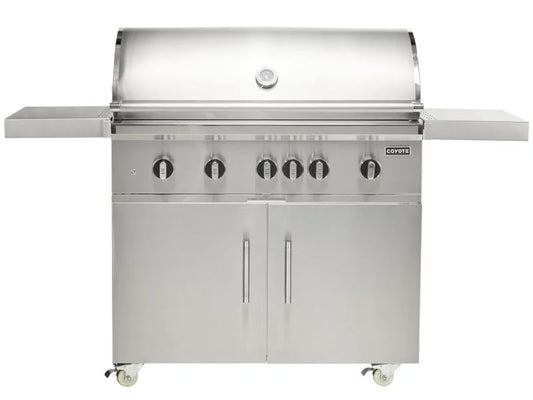
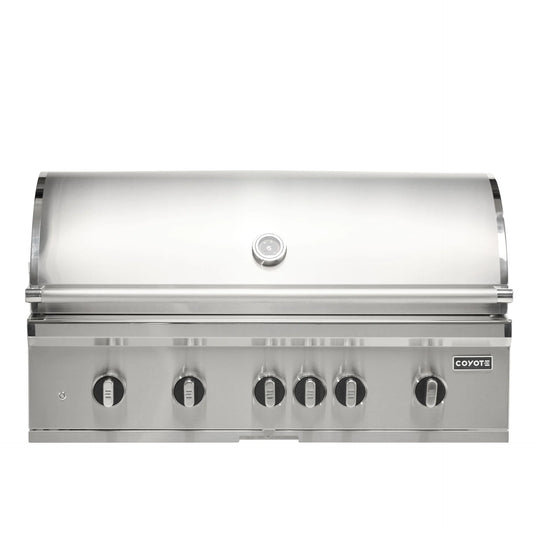
"36-inch" and "32-inch" are marketing labels, and brands do not use them the same way. Some name a grill by its overall width, some by the width of the cooking surface, and some by a series number. RCS, for example, names its Cutlass Pro grills by cooking-surface width, so its 42-inch model needs a 45-inch opening. Coyote's 36-inch CL- and SL-Series grills, by contrast, need an opening 32½ inches wide.
Width is also only one of three numbers. Two grills can share a width and still need different depths or heights. Summerset's Sizzler and Sizzler Pro share an 8-inch cutout height; its TRL Pro needs 9⅜ inches. A grill that is "the same size" as the one you have can still fail to drop in.
New build or replacement: two different questions
On a new outdoor kitchen, nothing is fixed yet, so the right order is: choose the grill, check whether its installation calls for an insulated liner, and then build the opening to those figures. The common mistake is framing or pouring the island first and shopping for a grill to fit it afterwards.
On a replacement, the opening, the countertop and the gas line are already there. The question becomes "which current grills publish a cutout that works with this opening?" — and, where none match exactly, what modification would be needed and who should do it.
What to gather before you ask for help
- The existing grill's brand and model, if you are replacing one. The rating label is often on the drip-tray area or inside the access door.
- The opening's width, depth and height, measured to the nearest ⅛ inch. Measure the cutout, not the grill.
- Fuel type — natural gas or propane — and whether there is a power outlet in the island.
- Island construction — masonry, steel frame or wood framing — because it bears on whether a liner is needed.
- A few photos: the grill straight on, the countertop edges around the opening, and the connection area if you can see it through an access door.
- A budget range and any brands you already favour.
Please do not disconnect the gas or lift out an installed grill to measure it. A model number and photos are usually enough to start, and an installer can confirm the opening when the old head comes out.
Why depth, height, clearances, liners and support matter
Depth decides whether the new firebox clears the back wall of the island. Height decides whether it clears whatever sits below the countertop — a shelf, framing or the island floor. Clearances behind and above the grill decide whether the lid opens fully and whether the installation meets the manufacturer's instructions.
Liners change the opening itself. Coyote's 36-inch insulated jacket calls for a 35¾" × 22⅛" × 11" opening, noticeably larger than the 32½" × 20½" × 10¼" cutout for the grill alone, and Coyote's manual requires a jacket when the grill is within 24 inches of combustible material below the countertop. Our liner guide covers the general pattern.
Support matters because many built-in grills hang from their side flanges on the countertop. An opening that has been widened too far can leave the grill without enough edge to sit on.
An illustrative replacement example
The following is a hypothetical scenario, written to show the process. It is not a real customer, and the figures are invented for illustration.
A homeowner's old grill is described as "32-inch". The brand is no longer sold. Measured carefully, the opening is 30⅞ inches wide, 20¼ inches deep and 9 inches high, in a concrete-block island with a granite top and a natural gas line.
Searching for "32-inch built-in grill" would return models whose published cutouts vary in every direction. Working from the measurements instead, the comparison sorts current models into three groups: those whose published cutout is within the opening on all three dimensions; those that would need the countertop opening enlarged, which is work for a stone fabricator; and those that need more depth or height than the island offers, which usually rules them out. Each group is then checked for natural gas availability, a matching liner if one is listed, and whether the flange will still bear on the countertop.
The useful result is not "this one fits". It is a shortlist with the reasons attached, the manufacturer's installation documents for each model, and a clear list of what the installer must confirm on site.
How Northwoods Grills helps you compare
We are a retailer, not an installer. We compare your measurements and plans with the manufacturer's published cutouts, liner requirements and fuel options, and we tell you where a model looks workable, where it does not, and where the manufacturer has not published what we need. We do not cut countertops, fabricate adapters or visit job sites, and we will not call a grill a drop-in fit from a width figure or a photo. Final measurements, structural support, gas and electrical work and installation belong to a qualified installer working from the manufacturer's current instructions.
If you want to browse first, the cutout dimensions reference and the replacement grill finder list published figures by brand and by cutout width.
FAQ
Is a 32-inch grill a standard replacement size?
No. Grills sold as 32-inch from different brands can need different cutout widths, depths and heights. Compare the published cutout with your measured opening.
Can I measure the old grill instead of the opening?
Measure the opening if you can. The grill's overall width includes the flanges that rest on the countertop, so it is not the cutout size.
What if no current grill matches my opening?
The usual options are enlarging the countertop cutout, adding supports, using filler panels or a professionally designed adapter. Each should be done by a qualified professional and checked against the new grill's installation instructions.
How do I ask for help?
Use the form on our built-in grill fit help page, or call 843-212-7209.